Krishval Musings

Monday, 2 March 2015


ENDANGERED INDIAN HIGHER EDUCATION
LEARN FROM RAMAYANA AND MAHABHARATHA


“Over the next few decades, as we tried to reach education to the lowest common denominator, we constantly lowered standards so that the weakest could catch up. As a result the average intellectual capacity of our nation today is determined not by our brightest, but by our dumbest.”  (Ghazala Wahab
India enjoyed an enviable reputation in the international theatre due to her very rich culture and heritage derived from high level of education.   Bharath produced many scholars, philosophers and scientists whose research works were stepping stones for the entire world.
Education which brought fame and respect to India all these centuries is being spoiled by short sighted approaches and deliberate dilution of standards. Indian education which was in the hands of highly dedicated and erudite scholars supported by philanthropists who respected  education is now being managed by  selfish and rapacious politicians, movie magnates and fake holy men.   Education which was revered and respected is now reduced to a business where students are looked upon as customers.
There is a big clamour about the declining standard of our education and the below 30% employability of the graduates/post graduates.  The unscrupulous mass education programme has precipitated several malpractices   like   bribery , paper chasing, fake  certificates/degrees, showering of  high marks , appointment of less qualified tutors, mark sheet manipulations, name changing , copying in exams, impersonation of candidates,  tampering question papers, plagiarism,  cut &paste practice in research papers, making qualification insignificant  to price tags  for admission to professional courses and for recruitment of  teaching staff  and many more.   Majority of the students who have little interest and seriousness in learning but ambitious to get a degree are being pushed to pursue higher education. 
Lowering the standards to help the undeserving to get through is a dangerous trend that is swamping the educational system which will have a serious negative impact on the growth of the nation.    
Lesson from Ramayana
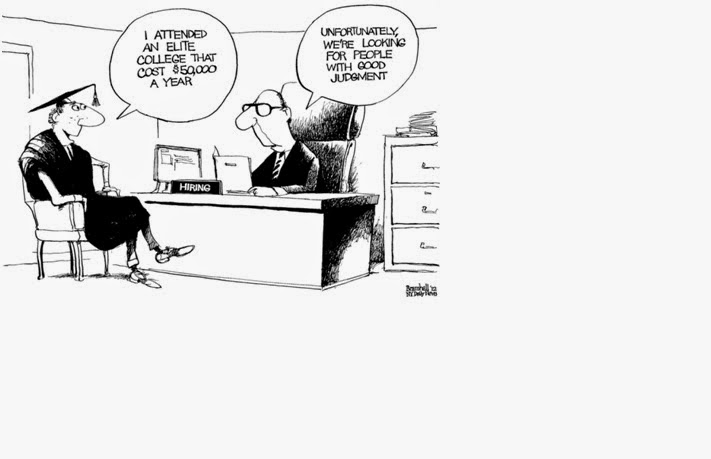
Private universities boast about their modern building, A/C classrooms, high style furnishing, restaurants, large play area, cultural activities and foreign tours etc. but are silent about the quality of faculty and standards of curriculum.  They try to sell not only low quality education but also false dreams to the innocent and ignorant boys and girls.  All universities circle around marks, grades and placements.
King Dasaratha got his four sons after a long wait.  He brought them up like jewels.    He was a very learned person who had a complete sense of value on education.  He could have easily built a mansion for the Guru Vasishta and asked him to give tuition to the princes for their education.  Instead, he sent them to Gurukulam where the boys had to stay at the Guru’s hut, sleep on the floor, fetch him water, clean his house, wash his clothes, do all services   and try to learn as much as possible. They learned the disciplined way and   realized the value of education.
                                              Sri Rama in Gurukulam


Education has to be earned. It is neither a product that can be bought over the counter nor a gift or compliment.  Mahatha Shramena, Mahatha Shradhaya cha” - We earn education with lot of efforts and dedication.
LESSON  FROM MAHABHARATHA
Removing all the bars like ethnicity, caste, religion, gender and financial capacity should be in place so that equal opportunity is given to all; but the standard bar should be elevated in post graduate and research studies to maintain high quality.  Higher education should be only for those who have the interest and ability to pursue it.
Guru Dhronacharya in Mahabharatha made it clear that he will teach and guide only the Kshatriyas (Royal family) in the art of warfare. Secular social scientists criticized it as arrogance of casteism.  His approach had no caste discrimination; it was pure rational thinking.  Kshatriyas have the natural inclination and seriousness to learn because it is required for them to run the government and protect their citizens.   Dhronocharya wanted only such students having the commitment and concentration to learn.
Ekaliva was an exception and not an example. Similarly a Sheppard called Kalidasa who became a great poet by the grace of Goddess Saraswathi was also an exception.
Dedicated teachers are vexed with the influx of unfit and disinterested students.   The system is further roiled as the teachers are made scapegoats for their poor performance.   The teacher/student relationship has become meaningless without mutual respect and trust. 
Conclusion.
The low employability is not only due to rote education system but also the dilution of its standards.
Prof. Arun Kumar of JNU, Delhi wrote “Many Indian intellectuals tend to be “derived intellectuals” recycling knowledge from the West. Government’s ‘Make in India’ programme depends on strong R&D capability which in turn requires a dynamic system of higher education.”(The Hindu Jan/8/2015)      
Scholars including the President of India have been blathering about the poor quality of education.  No action will be taken because dilution has become a populist game to influence vote banks.  The deterioration is also due to depriving the deserved   from pursuing higher education due to socio-political pressure. Over pampering the weak at the cost of the qualified will backfire on the quality of the future teaching staff.
Indian education is becoming a factory where the students are manufactured rather than developed and groomed.  An army of mediocre graduates /post graduates rolled out of diluted education system are now available for the progress of India. Indian intellects are already puzzled to find the prestigious IITs and IIMs rank after 200 in the list of top universities in the world; netting them into the dilution process will push them further down in the list.   Education, the powerful weapon of India, is getting blunted; a bold corrective action is required sooner than later.
The procedure of Ramayana and Mahbharatha may not be suitable now, but they had the right approach for quality education. 

Dr. Krishnan Arunachalam

( Published in The Mylapore Club Magazine February/2015) 


Saturday, 24 January 2015

Suit case – An All Party Symbol in Indian Politics.

Suit case – An All Party Symbol in Indian Politics. 

                                                 http://yogeshdevaraj.wordpress.com/


About two dozens of suit cases of same size stacked above the wardrobe in a politician’s house caught the attention of a news reporter while interviewing him. He became curious and enquired about them. The politician replied that they were all given to him as gifts by his friends and relatives. Reporter,” do you use them all”. Politician said “yes, during traveling”. Is one suit case not enough for multiples of travels? – Reporter.  The clever response was that he uses them all in order to please his friends and relatives.  

Citizens with knowledge about Indian politics know that suit cases are not gifted empty particularly to politicians.  The contents are currency notes with Mahatma Gandhi’s picture on it and content value depends upon the nature of favour expected from the politicians.  The true meaning of friends and relatives is an open secret.  Suit cases are normally gifted during the night to hide the identity of the friends and relatives!  Gutsy politicians however, do not hide them in secret dens as they no longer worry about the raid of government agencies.  A central minister, when Enforcement Directorate discovered suit cases containing bundles of gifted notes in his residence a few years ago, very casually responded to the press that he had absolutely no idea about who brought and kept them inside his residence. 

Gifting suit cases were not common in South India until 1980.  It used to be medium size brief cases.  A sportive and energetic Chief Minister from Bangalore took the initiative of promoting the brief case to suit case. It had the contagion effect and other Southern states immediately took steps and replaced brief cases with suit cases.  Size and number of suit cases determine the status and power of the politician.  Brief cases are still in operation but relegated to district level and petty politicians in the rural area.  In selected deals brief cases are used in state capitals towards ‘token advance’ or compliments to seek appointment with party chiefs.  

People of a Southern city still remember the story of transportation of a few hundreds of suit cases immediately after the death of a chief minister.  The death news was withheld for three hours until the total removal of the suit cases from his residence.  There was a scramble among very high level party workers within the three hours to grab as much as possible from the booty.  The suit cases were successfully moved to a far off place in three trucks.  It is rumoured that the escorting confident party men knocked off a few dozens of them on the way and diverted to their den.  This may not be possible now as they are all properly accounted and entrusted with more than one loyal person.  Effective contingency plans are also in place to ensure their safety.   

Suit cases generally travel by air for safety and security purpose.  Airport officials avoid questioning the content even if they see them in their detector.  They have a clear idea about its origin, the destination and the ultimate recipient.  Stopping them will boomerang on them either by stopping of promotion; transfer to remote places and in chronic cases threat of enquiry commission.  Flights to Delhi from Mumbai, Ahmedabad, Chennai, Hyderabad and Kolkata carry the maximum number of suit cases.  Smaller sizes and brief cases travel within the state like Madurai/ Coimbatore to Chennai, Cochin/Calicut to Trivandrum and Nagpur/Pune to Mumbai. It is always an accompanied baggage and there are professionals who handle the transportation task and have the ability to tackle the situation in case of any waylaying by authorities.  Now a day’s politicians travel with ‘gift suit cases’ without fear as it has become a normal practice.  

Traffic of suit cases gets momentum as soon as the elections are announced particularly for the parliament and state assembly.  Initially it will be within the   political group.  Competition to get the party ticket flags off the traffic.  Corporate bodies will slowly enter as and when the exit poll results are announced by the media. There will be hectic activities of exchanges when coalition arrangements are under way.  During the final stage of election they fly to different destinations to meet the election expenditure.  The retail distribution is generally operated through ambulances and school buses to escape checking by vigilantes. Full scale corporate involvement will begin once the ruling party settles down in the canopy. 

Suit cases remain above party politics. Opposition parties deliberately do not venture to check their transportation for two reasons; first they may perhaps contain their share of the gift and second, it is needed from the same source when they come to power.  They are only keen to know the person or the company which dispatched it and the purpose. This information goes into their data base for future needs.

Gone are those days when suit cases were used by smugglers. They have started playing an important role in Indian politics.  They have gained a kind of diplomatic immunity in all air ports particularly where the destination is New Delhi or the state capitals. As the GDP of India is growing with too many foreign investments and SEZ proposals, its domain has expanded substantially in the last decade into  bureaucracy and the top management of government controlled institutions. Attempts were also made to penetrate into judiciary. Suit cases are known as “Potti” in Tamilnadu and its content value has multiplied from  Rs. One crore in 2005 to Ten crores in 2014.  Suit cases have become an important force in the political economy of India; their size and content value closely follow the GDP growth. 
 
Indians should sincerely pray that suit case does not become a national symbol.  

“Sathyameva Jayathe” perhaps.

Dr.Krishnan  Arunachalam 

Ref:  MSN blog in 2006 by the author

http://www.storypick.com


(Published in Mylapore club Magazine January/2015)